
[Activity insight] The burden of learning to be more critical
As AI slop (AI-generated soulless generic content) is exponentially taking over content on the internet, it's crucial that we become critical of what we find when searching for information. But how?

AI browsing
“What’s the highest peak in the world?”
“I don’t know, let’s Google it!”
“Oh, come on, you’re such a millennial, I’ll just ask ChatGPT instead.”
This little made-up dialogue might as well try to illustrate generational differences (a huge trend by the way on social media…) but it also shows a shift I’ve noticed in my environment: While Google used to be the go-to quick tool for finding information for long years, now more and more people (esp. the younger generation) asks ChatGPT instead.
Oh, but don’t think that Google is crying in the corner as the last pillar of “truth” because it is also aggressively integrating its own AI overview into the search results, pushing real websites in the background. And as AI-powered search engines, like Perplexity’s Comet or OpenAI’s Atlas, appear on the scene, it’s going to be more and more difficult to stay in control of finding, comprehending, and organising credible information. Many sources claim that AI browsing has broken the internet as we know it.
“Agentic browsing and search exacerbate the problem. In both cases, human eyes are no longer on the publisher’s website,” […] “The trend continues that more people can get more answers to more questions without ever visiting the source.” (IBM)
So what does this mean for us, educators?
To be honest, I’m also at a loss… Obviously, it means that we need to put an even bigger emphasis on developing critical thinking to wade our way through untrustworthy or just simply AI-generated information (of which we now seem to have as much as of human-generated), but now it seems to me like we’re trying to find our way in the ever growing darkness. At first, you can still make out shapes and figures, you can orient yourself but as the darkness is growing around you, you no longer see the edges of objects, and everything just becomes a complete black blob.
Some sources say that this will eventually bring us back to where it all started: a handful of (credible?) sources we trust. Because if you grow tired of constantly evaluating every single piece of information, you’ll either completely give up caring and will believe whatever you find just to keep going or you’ll abandon search engines (or the entire internet even) completely and choose one or two sources you decide to trust forever.
As educators, I believe our major task right now is to equip our students with some foundational knowledge and skills that help them notice if something is fishy. It’s certain that we can’t become walking encyclopaedias but we can enhance our senses that tell us that we need to look further for the right information.
Basic steps to improve critical thinking skills
The easiest way to develop our students’ critical thinking skills is if we make them work for the information they’d like to receive.
Use inductive teaching techniques instead of deductive ones. Let them find the rule themselves by noticing patterns instead of telling them yourself. Present the new language in context, use guided discovery sheets, ask many guiding questions.
Let students experiment until they find the right solution - don’t rush in with the correct answer right away. This could be especially useful in exam preparation classes, for example, in the case of multiple choice reading and use of English activities. There are of course parts of learning the language when it doesn’t do any good if you let them wander aimlessly, e.g., trying to remember irregular verbs.
Let them explore different viewpoints when discussing a question or during a debate. One easy way to do this is to give them different roles, such as in the Six Thinking Hats game.
Give them tasks which don’t have one correct answer. One of my favourites is when you ask them to classify a group of random vocabulary items. As long as they can justify their version of grouping, they have used their brains and they have engaged with the words.
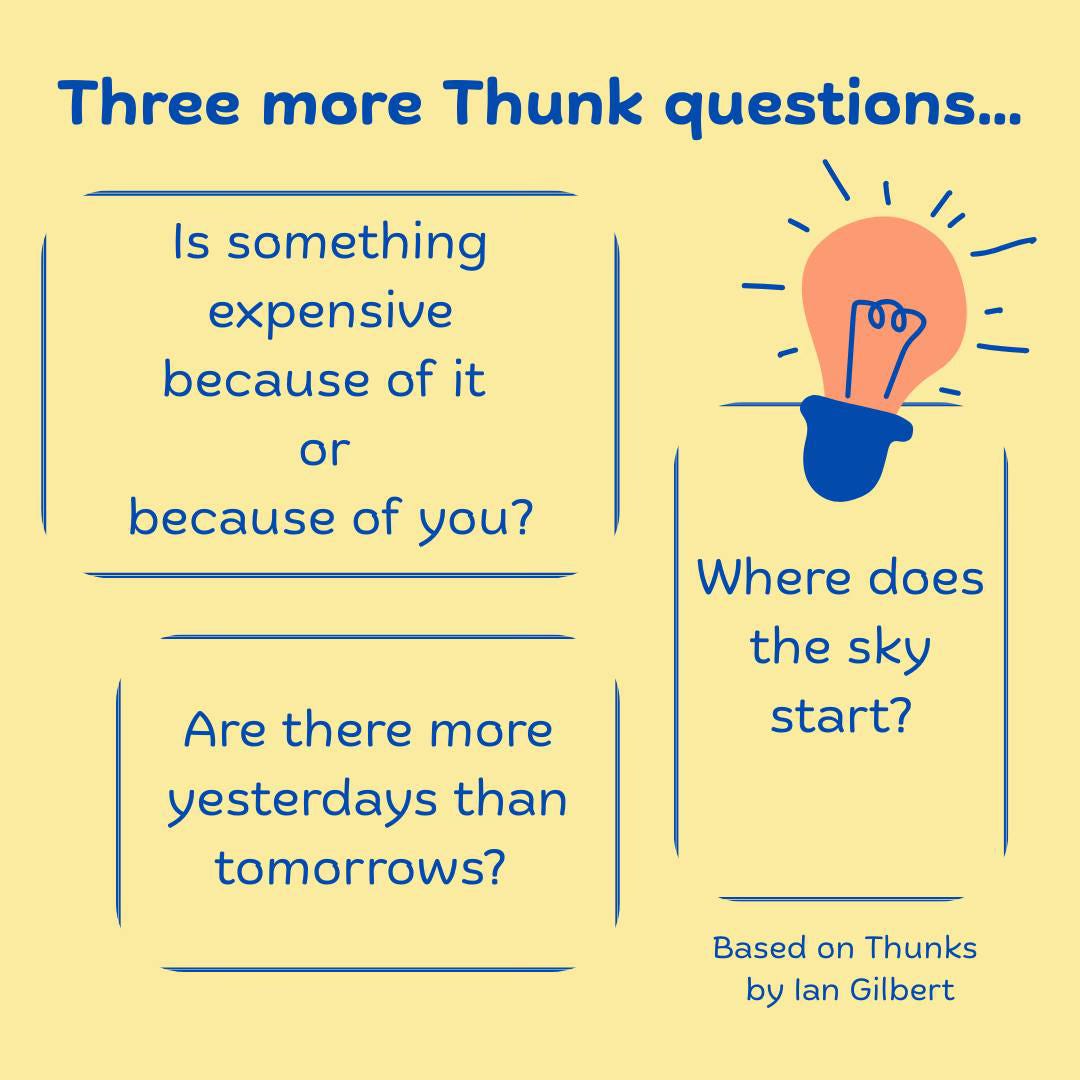
My new favourite is the so-called thunk questions. I first learned about them thanks to Fiona and Theresa’s podcast, Tea with Fi an T. Thunk questions, created and collected by Ian Gilbert (check out his book), have no wrong answer and are designed to make you think and see the world differently.

image source: https://www.facebook.com/profile.php?id=61581977669069
Practicing critical thinking in the age of AI
Now, this is getting much more difficult day by day as AI-generated content is getting more and more convincing.
For example, look at this fantastic photo and the comment I found below it:

But I’ve got another one. It was a video of kangaroos jumping in the sea with the caption “Nature is so beautiful.” In the comments, people went wild trying to convince each other that kangaroos in Australia do hop into the sea or that the video is indeed AI-generated.
The most we can do at the moment is double-check everything:
by doing a reverse image search on Google,
by asking for and checking the sources the chatbot provides in its response,
or by searching for the same thing on Google and checking how many and what kind of sources mention the same piece of information.
Still, this only works if 1. we take the time to check, 2. if we can still distinguish fake from real.
Activities from our book with this focus
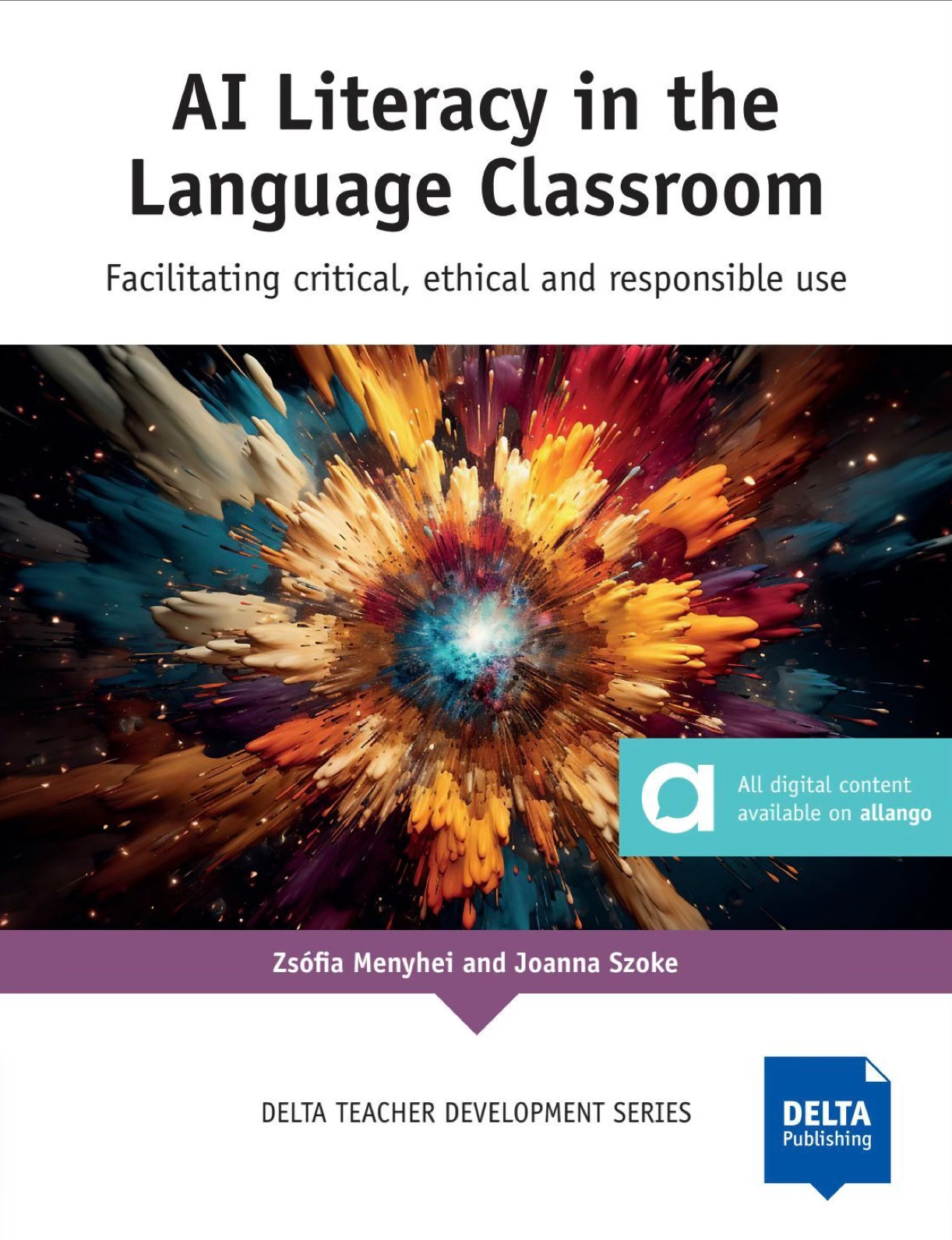
Apples to oranges (p. 61): In this activity students bring a text they have written to class and prompt an AI chatbot to create a version of the same text. They then use a set of criteria to critically compare their own writing with the AI-generated content. This process encourages students to reflect on their writing skills while also evaluating the AI as a tool.
Deepfake dilemma (p.65): This activity raises students’ awareness of deepfakes and encourages critical thinking about their risks and potential positive applications. It also provides students with opportunities to learn relevant vocabulary connected to the topic of AI and media literacy, with terms such as synthetic media, disinformation, misinformation, and defamation naturally emerging during the lesson.
Credibility officers (p. 67): This self-discovery activity helps students learn how to fact-check AI-generated responses using appropriate sources. This isn’t only useful for developing responsible AI usage, but it is also especially beneficial for students in academic English language courses, where understanding essay writing and properly crediting sources is a key focus.
Perspectives hot seat (p. 104): This activity helps explore different stakeholders’ perspectives on using AI through roleplay. It can be used early in a
workshop on teaching for AI literacy.

Wow, the part about agentic browsing really stood out. The idea of human eyes no longer on the publisher’s website is so intriguing, and a bit daunting for us teacher's. Spot on!